1. Introduzione al tuo manuale
This Haynes Service and Repair Manual provides detailed, step-by-step instructions for the maintenance, service, and repair of Vauxhall/Opel Astra models produced between May 2004 and 2008. It specifically covers diesel engine variants, including 1.3, 1.7, and 1.9-liter engines. The manual is designed to assist both the home mechanic and the professional technician in performing various tasks, from routine servicing to more complex repairs.
The information presented is based on a complete stripdown and rebuild of the vehicle, ensuring accuracy and practicality. Always refer to the specific sections for your vehicle's engine and transmission type.
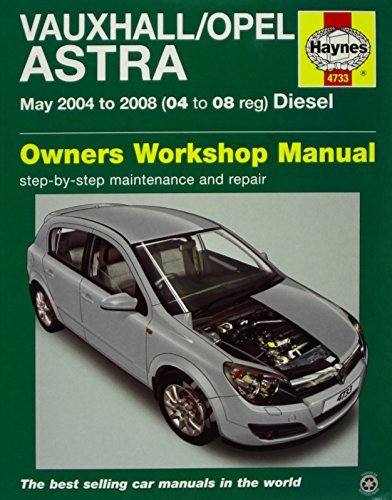
This image displays the front cover of the Haynes Service and Repair Manual, featuring a grey Vauxhall/Opel Astra car with its bonnet open, revealing the engine bay. The cover prominently displays the title 'VAUXHALL/OPEL ASTRA May 2004 to 2008 (04 to 08 reg) Diesel' and the Haynes logo with the manual number 4733.
2. Informazioni generali sulla sicurezza
Before commencing any work on your vehicle, it is crucial to observe all safety precautions. Failure to do so can result in personal injury or damage to the vehicle. Always wear appropriate personal protective equipment (PPE) such as safety glasses, gloves, and sturdy footwear.
- Supporto veicoli: When working under the vehicle, always use axle stands in conjunction with a jack. Never rely solely on a jack to support the vehicle.
- Sicurezza della batteria: Disconnect the battery's negative terminal before working on any electrical components to prevent accidental short circuits. Be aware of hydrogen gas emissions from batteries, which are highly flammable.
- Componenti caldi: Engine and exhaust components can remain hot for a considerable time after the engine has been switched off. Allow sufficient time for cooling before handling.
- Fluidi: Engine oil, coolant, brake fluid, and fuel can be hazardous. Handle with care, avoid skin contact, and dispose of them responsibly according to local regulations.
- Sistema di alimentazione: Exercise extreme caution when working on the fuel system. Ensure adequate ventilation and have a fire extinguisher readily available.
3. Routine Maintenance and Servicing
Regular maintenance is essential for the longevity and reliable operation of your Vauxhall/Opel Astra. This section outlines key routine service procedures.
3.1 Engine Oil and Filter Change
- Warm the engine to operating temperature, then switch off.
- Position a suitable drain pan beneath the sump.
- Remove the sump drain plug and allow the oil to drain completely.
- Rimuovere il vecchio filtro dell'olio.
- Install a new oil filter, ensuring the rubber seal is lightly lubricated with new oil.
- Refit the sump drain plug with a new washer and tighten to the specified torque.
- Refill the engine with the correct grade and quantity of new engine oil.
- Start the engine, check for leaks, and verify the oil level after a few minutes.
3.2 Sostituzione del filtro dell'aria
The air filter should be inspected regularly and replaced as per the manufacturer's schedule or if visibly dirty.
- Locate the air filter housing, typically in the engine bay.
- Unclip or unscrew the housing cover.
- Rimuovere il vecchio elemento del filtro dell'aria.
- Clean any debris from the housing.
- Insert the new air filter, ensuring it is correctly seated.
- Secure the air filter housing cover.
3.3 Fuel Filter Replacement (Diesel)
The diesel fuel filter requires periodic replacement to ensure clean fuel delivery to the engine.
- Locate the fuel filter housing.
- Place a suitable container to catch spilled fuel.
- Disconnect fuel lines and electrical connectors (if present).
- Rimuovere il vecchio filtro.
- Install the new filter, ensuring correct orientation.
- Reconnect fuel lines and electrical connectors.
- Bleed the fuel system as per manufacturer instructions (often by cycling the ignition or using a primer pump).
- Dopo aver avviato il motore, verificare la presenza di perdite.
4. Engine Management and Systems
This section covers the various components and systems related to the diesel engine, including fuel injection, turbocharging, and emission control.
4.1 Fuel Injection System
The diesel fuel injection system is a high-pressure system. Components include the fuel pump, common rail, injectors, and associated sensors. Diagnosis and repair of these components often require specialized tools and knowledge.
- Injector Removal/Installation: Detailed steps for safely removing and installing fuel injectors, including necessary precautions for high-pressure lines.
- Fuel Pump Inspection: Procedures for checking fuel pressure and flow, and diagnosing common fuel pump issues.
4.2 Turbocharger System
The turbocharger boosts engine performance. Regular inspection of hoses, connections, and the turbocharger unit itself is recommended.
- Boost Pressure Check: How to verify correct boost pressure using diagnostic tools.
- Turbocharger Removal: Steps for safely detaching the turbocharger unit for inspection or replacement.
5. Sistema frenante
The braking system is critical for vehicle safety. This section details maintenance and repair procedures for disc and drum brakes, as well as the Anti-lock Braking System (ABS).
5.1 Disc Brake Service
- Sostituzione pastiglie: Step-by-step guide for replacing front and rear brake pads.
- Ispezione del disco: How to check brake discs for wear, warping, and minimum thickness.
- Manutenzione pinza: Cleaning and lubricating caliper slide pins.
5.2 ABS System
The ABS system prevents wheel lock-up during braking. While complex, basic checks can be performed.
- Ispezione del sensore: Visual check of ABS wheel speed sensors and wiring for damage.
- Warning Light Diagnosis: Understanding common causes for the ABS warning light illumination.
6. Risoluzione dei problemi comuni
This section provides guidance on diagnosing and resolving common issues that may arise with your Vauxhall/Opel Astra.
| Sintomo | Possibile causa | Azione |
|---|---|---|
| Il motore gira ma non si avvia | Low fuel pressure, faulty glow plugs, immobilizer issue | Check fuel filter, test glow plugs, check for diagnostic trouble codes (DTCs) |
| Surriscaldamento del motore | Low coolant level, faulty thermostat, radiator blockage | Check coolant level, inspect radiator and hoses, test thermostat operation |
| Brakes squeal or grind | Worn brake pads, contaminated pads/discs, seized caliper | Inspect brake pads and discs, clean components, check caliper function |
| Excessive exhaust smoke (diesel) | Worn injectors, faulty turbocharger, DPF issues | Consult a specialist for diagnosis of fuel system or turbocharger |
7. Specifiche tecniche
This section provides general technical data and specifications for the Vauxhall/Opel Astra (2004-2008) Diesel models. Always refer to the detailed tables within the manual for specific engine variants and torque settings.
- Capacità olio motore: Varies by engine type (e.g., 1.3L, 1.7L, 1.9L). Refer to manual for exact figures.
- Tipo di refrigerante: Specific long-life antifreeze (e.g., Dex-Cool compatible).
- Tipo di liquido freni: DOT 4.
- Pressione degli pneumatici: Refer to the vehicle's placard (usually on the driver's door jamb or fuel filler flap) for recommended pressures based on tire size and load.
- Impostazioni di coppia: All critical fasteners have specific torque settings. These are detailed in relevant sections of the full manual and must be adhered to for safety and proper function.
8. Garanzia e supporto
This Haynes Service and Repair Manual is an independent publication designed to assist vehicle owners and technicians. It does not provide a warranty for the vehicle itself, which would be covered by the original manufacturer's warranty if applicable.
For support regarding the content or use of this Haynes manual, please refer to the publisher's contact information typically found within the manual's introductory pages or on their official website. Any repairs or modifications performed using this manual are the responsibility of the individual undertaking the work.