
1. Introduzione
The Pyle PDWM8325 is an 8-channel UHF wireless microphone system designed for professional audio applications. This system provides clear, reliable wireless audio transmission for up to eight microphones simultaneously, making it suitable for live performances, presentations, studio productions, and karaoke. The rack-mountable receiver features independent volume controls for each channel, digital LCD displays, and versatile audio output options.
2. Contenuto della confezione
Please inspect the package carefully to ensure all items are present and in good condition.

Figura 1: Contents of the Pyle PDWM8325 package. This image displays the main receiver unit, eight handheld wireless microphones, four detachable antennas, a 1/4 inch audio connection cable, a wall power adapter, and AA batteries for the microphones.
- Microphone Receiver Base (1 unit)
- Handheld Microphones (8 units)
- 1/4 inch Audio Connection Cable (1 unit)
- Wall Power Adapter (1 unit)
- AA Batteries (16 units, 2 per microphone)
- Telescoping Receiver Antennas (4 units)
3. Prodotto finitoview
3.1 Unità ricevente
The receiver unit is the central component of the wireless system, designed to receive signals from all eight microphones. It features a rack-mountable design for integration into existing audio setups.

Figura 2: Front and rear panels of the receiver. The front panel includes digital LCD displays for each channel's frequency, power switch, and wireless netting indicator. The rear panel features antenna connectors, individual channel volume controls, 1/4 inch mixed output, XLR balanced output, and the DC power input.
Caratteristiche del pannello frontale:
- Digital LCD Displays: Show the operating frequency for each of the 8 channels.
- Interruttore di alimentazione: Turns the receiver unit on or off.
- Wireless Netting Indicator: Indica lo stato del segnale wireless.
Caratteristiche del pannello posteriore:
- Connettori dell'antenna: For attaching the included telescoping antennas.
- Individual Channel Volume Controls: Rotary knobs to adjust the output level for each microphone channel independently.
- 1/4 inch Mix Output Jack: Unbalanced audio output for connecting to mixers or amplificatori.
- Jack di uscita bilanciato XLR: Professional balanced audio output for connecting to mixers or audio interfaces.
- Ingresso CC: For connecting the wall power adapter.
3.2 Microfoni palmari
The system includes eight handheld wireless microphones, each designed for comfortable use and reliable performance.
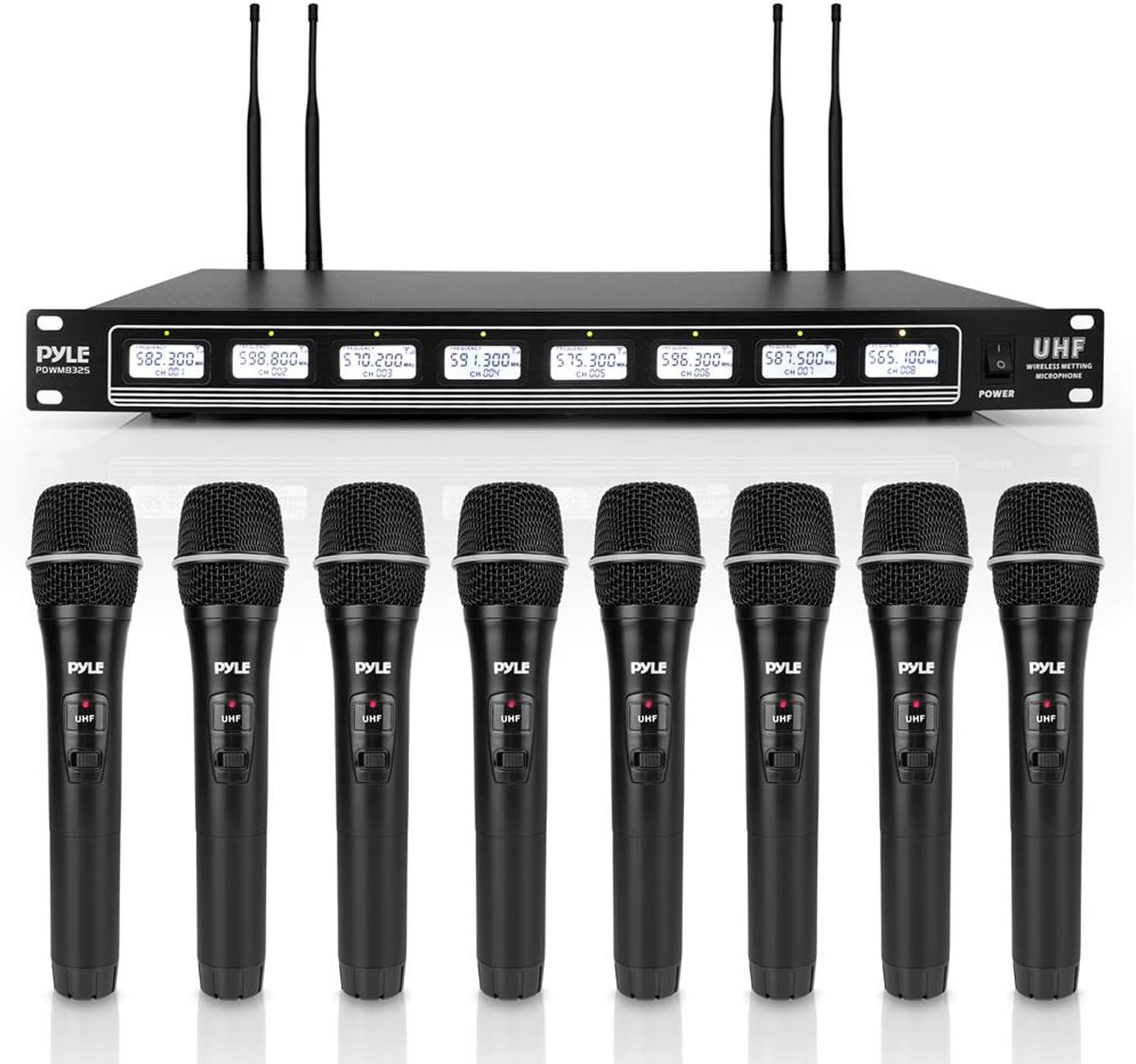
Figura 3: The complete Pyle PDWM8325 system, featuring the receiver and eight handheld microphones. Each microphone has an on/off switch and operates on UHF frequency.
- Interruttore di alimentazione: Located on the microphone body to turn the microphone on or off.
- Vano batteria: Located at the base of the microphone for two AA batteries.
- Frequenza UHF: Each microphone operates on a fixed UHF frequency, corresponding to one of the receiver's channels.
4. Istruzioni per l'installazione
Follow these steps to set up your Pyle PDWM8325 wireless microphone system.
4.1 Posizionamento del ricevitore
- Place the receiver unit in a stable location, preferably within a standard audio equipment rack. Ensure adequate ventilation around the unit.
- Keep the receiver away from strong electromagnetic interference sources (e.g., computers, motors, large metal objects) to prevent signal disruption.
4.2 Collegamento dell'antenna
- Screw the four telescoping antennas securely into the antenna connectors on the rear panel of the receiver.
- Adjust the antennas to an upright position for optimal signal reception.
4.3 Collegamento di alimentazione
- Connect the included wall power adapter to the DC input jack on the rear of the receiver.
- Collegare l'alimentatore a una presa elettrica adeguata.
4.4 Collegamento uscita audio
Collega il ricevitore al tuo mixer audio, amplifier, or PA system using one of the following methods:

Figura 4: A hand connecting a 1/4 inch audio cable to the receiver's mixed output jack. The image also shows the power switch on the front panel and the XLR balanced output jack on the rear.
- 1/4 inch Mix Output: Use the supplied 1/4 inch audio cable to connect the receiver's 'AUDIO MIX OUT' jack to an available input on your mixer or amplifier. This output combines all 8 microphone signals into a single mono output.
- Uscita bilanciata XLR: For professional connections, use an XLR cable (not included) to connect the receiver's 'BALANCED' XLR output to a balanced input on your mixer or audio interface. This also provides a combined output of all channels.
4.5 Installazione della batteria del microfono
- Unscrew the bottom cap of each handheld microphone to reveal the battery compartment.
- Insert two AA batteries (included) into each microphone, ensuring correct polarity (+/-).
- Riavvitare saldamente il tappo inferiore.
5. Istruzioni per l'uso
Once the system is set up, follow these steps for operation.
5.1 Accensione del sistema
- Turn on your audio mixer or amplifier first, ensuring its volume is set to a low level.
- Press the 'POWER' button on the front panel of the receiver unit. The LCD displays should illuminate, showing the operating frequencies.
- Slide the power switch on each microphone to the 'ON' position. The microphone's indicator light should illuminate.
5.2 Regolazione del volume
- Use the individual volume control knobs on the rear of the receiver to adjust the output level for each microphone channel.
- Gradually increase the master volume on your mixer or amplifier al livello di ascolto desiderato.
- Speak into each microphone to test its sound and adjust the individual channel volume as needed.
5.3 Utilizzo del microfono

Figura 5: A user holding and speaking into a Pyle handheld wireless microphone. For optimal sound, hold the microphone approximately 2-6 inches from your mouth.
- Per una ricezione ottimale del suono, tenere il microfono a circa 2-6 cm dalla bocca.
- Avoid covering the microphone grille with your hand, as this can affect sound quality and signal reception.
5.4 Intervallo operativo
The Pyle PDWM8325 system offers an extended operating range under ideal conditions.

Figura 6: Visual representation of the system's wireless range, indicating an ultra-long distance connection of up to 600 feet between the microphone and the receiver.
- The system has an operation range of up to 600+ feet in open, unobstructed environments.
- Walls, metal structures, and other wireless devices can reduce the effective operating range. Maintain a clear line of sight between the microphones and the receiver whenever possible.
5.5 Powering Off the System
- Turn off each handheld microphone by sliding its power switch to the 'OFF' position.
- Press the 'POWER' button on the receiver unit to turn it off.
- Turn off your audio mixer or amppiù vivace.
6. Manutenzione
Una corretta manutenzione garantisce la longevità e le prestazioni ottimali del tuo sistema microfonico wireless.
- Pulizia: Utilizzare un panno morbido e asciutto per pulire il ricevitore e i microfoni. Non utilizzare detergenti liquidi o solventi, poiché potrebbero danneggiare la finitura o i componenti interni.
- Sostituzione della batteria: Replace microphone batteries when the indicator light dims or audio quality degrades. Always use fresh AA batteries. Remove batteries if the microphones will not be used for an extended period to prevent leakage.
- Magazzinaggio: Conservare il sistema in un luogo fresco e asciutto, lontano dalla luce solare diretta e da temperature estreme.
- antenne: Maneggiare le antenne con cura per evitare piegature o rotture.
7. Risoluzione Dei Problemi
If you encounter issues with your Pyle PDWM8325 system, refer to the following troubleshooting guide:
| Problema | Possibile causa | Soluzione |
|---|---|---|
| Nessun suono dal microfono | Microfono non acceso Batterie scariche Ricevitore non acceso Cavo audio scollegato Volume del ricevitore troppo basso Miscelatore/ampvolume del filtro troppo basso | Ensure microphone power switch is ON Sostituire le batterie Ensure receiver power switch is ON Controllare tutti i collegamenti dei cavi audio Increase individual channel volume on receiver Increase volume on mixer/amppiù vivace |
| Poor sound quality / Static / Dropouts | Interferenza da altri dispositivi Microfono troppo lontano dal ricevitore Obstructions between mic and receiver Batterie del microfono scariche Antenne non posizionate correttamente | Move away from other wireless devices or electronics Ridurre la distanza tra microfono e ricevitore Assicurare una linea di vista libera Sostituire le batterie Adjust receiver antennas for optimal reception |
| Breve raggio d'azione | Interferenza ambientale Ostruzioni Antennas not fully extended or positioned | Minimize interference sources Assicurare una linea di vista libera Fully extend and properly position receiver antennas |
| Microphone indicator light off | Microfono non acceso Batterie scariche | Slide power switch to ON Sostituire le batterie |
8. Specifiche
Technical specifications for the Pyle PDWM8325 8 Channel UHF Wireless Microphone System:
| Caratteristica | Specificazione |
|---|---|
| Gamma di funzionamento | Fino a 600+ piedi (linea di vista) |
| Risposta in frequenza | 50 Hz - 16 kHz |
| Rapporto segnale/rumore | 90 dB |
| Gamma dinamica | 92 dB |
| Distorsione armonica totale | 0.5% |
| Potenza del microfono | (2) x AA Batteries (each) |
| Receiver Dimensions (without Rack Mount) | 1.8" x 16.5" x 8.7" (H x W x D) |
| Receiver Dimensions (with Rack Mount) | 1.8" x 18.9" x 8.7" (H x W x D) |
| Alimentazione elettrica | 110/240 V (adattatore di alimentazione CC 12 V) |
| Numero di canali | 8 |
| Fattore di forma del microfono | Portatile |
| Tecnologia di connettività | UHF Wireless, XLR, 1/4" Jack |
| Materiale | Plastic (Microphones), Metal (Receiver) |
| Peso dell'articolo | 6.3 lbs (Receiver) |
9. Garanzia e supporto
For warranty information or technical support regarding your Pyle PDWM8325 wireless microphone system, please refer to the warranty card included with your product or visit the official Pyle website. You may also contact Pyle customer service directly for assistance with product operation, troubleshooting, or parts replacement.