
Introduzione
Welcome to your new Skyoptikst 114EQ Reflector Astronomical Telescope. This manual provides detailed instructions for assembly, operation, maintenance, and troubleshooting to ensure optimal performance and enjoyment of your astronomical observations. Please read this manual thoroughly before using your telescope.
Contenuto della confezione
Verifica che tutti i componenti elencati di seguito siano presenti nel tuo pacchetto:
- 1 x 114-1000mm Astronomical Telescope Optical Tube
- 1 x Kellner 25mm Eyepiece (1.25'')
- 1 x Kellner 10mm Eyepiece (1.25'')
- 1 x Barlow Lens (2x)
- 1 x Finder Scope (6x30)
- 1 x Finder Scope Holder
- 1 x Equatorial Tripod (Aluminum Alloy)
Istruzioni di installazione
Per assemblare il telescopio, segui questi passaggi:
Step 1: Assemble the Tripod
Unfold the aluminum alloy tripod and extend the legs to a stable height. Secure the locking knobs on each leg to prevent movement. Ensure the tripod is placed on a level surface.

Image description: A sturdy aluminum alloy tripod with extended legs and locking mechanisms, designed for stability.
Step 2: Attach the Equatorial Mount
Securely attach the equatorial mount to the tripod head. Align the mounting holes and tighten all bolts firmly. The equatorial mount allows for precise tracking of celestial objects.

Image description: The equatorial mount assembly, including counterweights and slow-motion controls, mounted on the tripod.
Step 3: Mount the Telescope Optical Tube
Carefully place the telescope optical tube onto the equatorial mount's saddle. Ensure the tube is balanced and tighten the mounting rings to hold it firmly in place. Attach the counterweight to the counterweight shaft for proper balance.

Image description: The Skyoptikst 114EQ Reflector Telescope fully assembled on its equatorial mount and tripod.
Step 4: Install the Finder Scope
Attach the finder scope to its bracket on the main telescope tube. Align the finder scope with the main telescope during daylight hours by pointing at a distant, stationary object. Look through the main telescope with a low power eyepiece (K25mm) and center the object. Then, adjust the finder scope's alignment screws until the same object is centered in the finder scope's crosshairs.
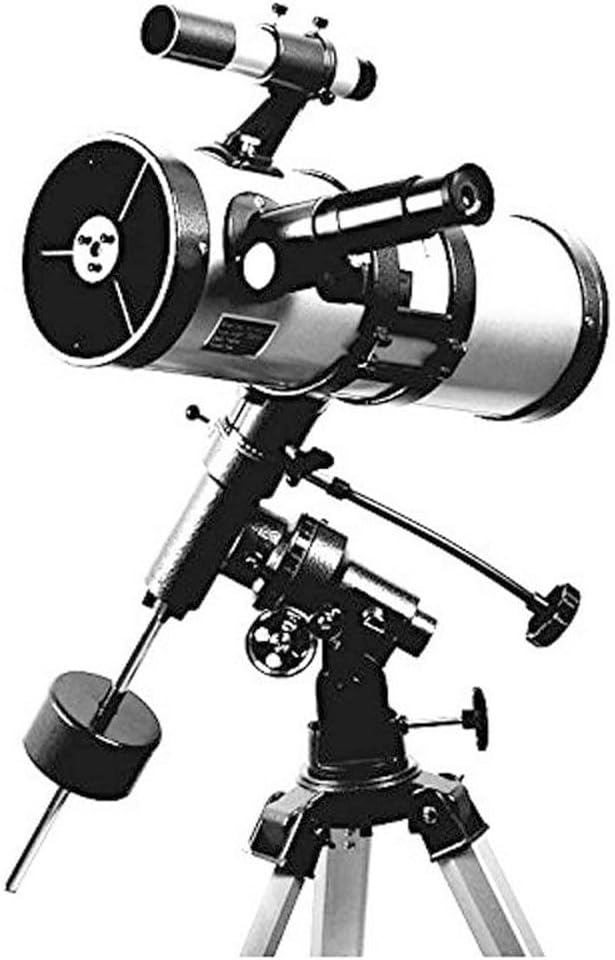
Descrizione dell'immagine: Un primo piano view of the telescope's optical tube with the finder scope attached.
Step 5: Insert Eyepieces and Barlow Lens
Insert the desired eyepiece (K25mm for wide views, K10mm for higher magnification) into the focuser. If using the 2x Barlow lens, insert it first into the focuser, then insert the eyepiece into the Barlow lens. Secure with the thumbscrew.

Image description: The focuser mechanism of the telescope, where eyepieces are inserted.
Istruzioni per l'uso
Messa a fuoco
To achieve a clear image, turn the focuser knobs slowly until the object appears sharp. Always start with the K25mm eyepiece for a wider field of view and easier object location, then switch to the K10mm for higher magnification and more detail.
Tracciamento di oggetti celesti
The equatorial mount is designed to track celestial objects as they move across the night sky due to Earth's rotation. Once an object is centered in the eyepiece, use the slow-motion controls on the Right Ascension (RA) axis to follow its path, keeping it within your field of view.

Descrizione dell'immagine: Un dettaglio view of the equatorial mount's slow-motion controls and setting circles, used for precise tracking.
Observing the Moon and Planets
The 114mm aperture of this reflector telescope is well-suited for observing the Moon's craters, mountains, and maria. It also provides excellent views of major planetary features, such as Jupiter's four Galilean moons and Saturn's rings. For optimal planetary viewing, choose nights with stable atmospheric conditions.

Image description: A detailed image of the Moon's surface, showcasing craters and maria, as seen through a telescope.
Deep Sky Observations
For fainter deep-sky objects like galaxies, nebulae, and star clusters, observe from a dark location away from light pollution. Use the K25mm eyepiece for wider views to locate objects, then switch to higher magnification with the K10mm eyepiece or 2x Barlow lens if desired for more detail.
Astrophotography (Optional)
This telescope can be adapted for basic astrophotography using a smartphone adapter (not included). Attach your smartphone to the eyepiece to capture images of the Moon and brighter planets.
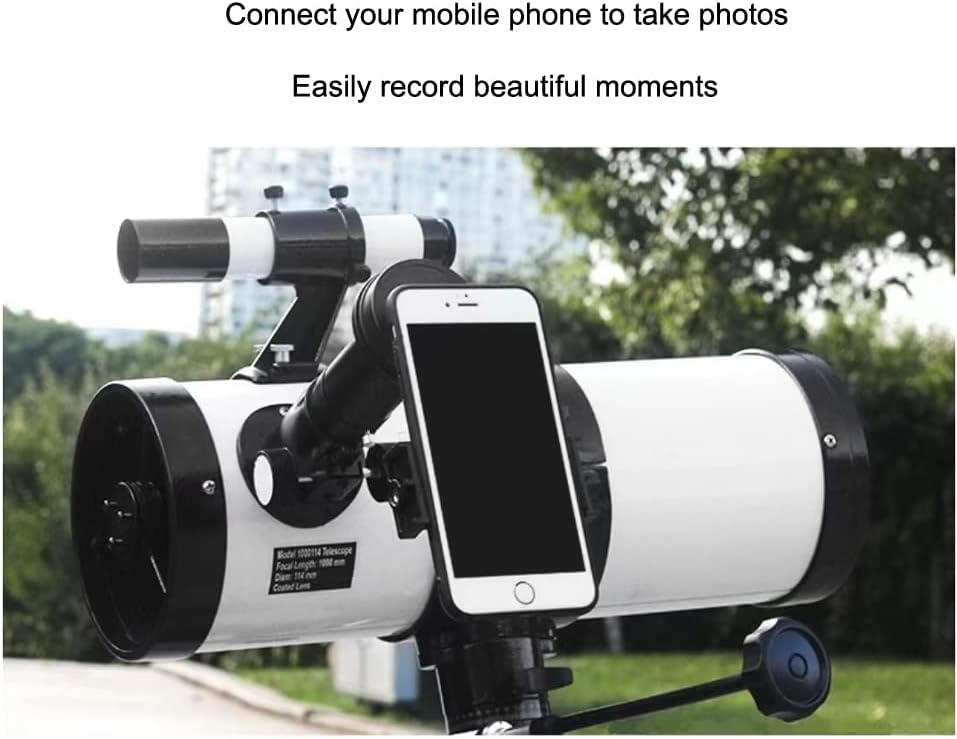
Image description: A smartphone attached to the telescope eyepiece, demonstrating how to capture images of celestial objects.
Manutenzione
- Cleaning Optical Surfaces: Keep the primary mirror, secondary mirror, and eyepiece lenses clean. Use a soft, lint-free brush or compressed air to remove loose dust. For smudges or fingerprints, use a specialized optical cleaning solution and a microfiber cloth designed for optics. Apply solution to the cloth, not directly to the lens.
- Magazzinaggio: Store the telescope in a dry, dust-free environment when not in use. Use dust caps for the optical tube and eyepieces to protect them from dust and moisture.
- Gestione: Avoid touching optical surfaces with bare hands as oils can leave residues.
- Controllo meccanico: Periodically check and tighten all screws and bolts on the mount and tripod to ensure stability and smooth operation. Do not overtighten.
Risoluzione dei problemi
- Problema: l'immagine è sfocata o fuori fuoco.
Soluzione: Adjust the focuser knobs slowly until the image appears sharp. Ensure the eyepiece is fully inserted and secured. Check for condensation on the lenses or mirrors, and allow the telescope to acclimate to the ambient temperature.
- Problem: Cannot find objects in the sky.
Soluzione: Ensure the finder scope is properly aligned with the main telescope. Start with the lowest magnification eyepiece (K25mm) for a wider field of view to locate objects. Practice locating bright objects like the Moon or bright stars first.
- Problem: Image appears dim or faint.
Soluzione: Observe from a dark location away from city lights. Allow your eyes to adapt to the darkness for at least 20 minutes. Ensure optical surfaces are clean and free from dust or smudges. The 114mm aperture gathers sufficient light for many celestial objects, but very faint deep-sky objects require optimal viewcondizioni.
- Problem: Telescope shakes or vibrates excessively.
Soluzione: Ensure the tripod legs are fully extended and locked, and placed on a stable, level surface. Check that all connections between the tripod, mount, and optical tube are securely tightened. Avoid touching the telescope during observation.
Specifiche
| Caratteristica | Specificazione |
|---|---|
| Primary Mirror Diameter | 114 mm (4.5 pollici) |
| Lunghezza focale | 1000mm |
| Oculari | K10mm, K25mm (1.25 inch diameter) |
| Lente di Barlow | 2x |
| Ambito di ricerca | Riflesso 6x30 |
| Tipo di telescopio | Riflettore |
| Tipo di montaggio | Montatura Equatoriale |
| Treppiedi | Aluminum Alloy, Maximum Height 135cm |
| Rivestimento delle lenti | Completamente multistrato |
| Dimensioni del prodotto | 30.71 x 15.35 x 14.57 pollici |
| Peso dell'articolo | 26 libbre |
| Numero di modello | T114-1000EQ-FBA |
Informazioni sulla garanzia
This Skyoptikst telescope is covered by a manufacturer's warranty against defects in materials and workmanship. Please refer to the warranty card included with your product for specific terms and conditions, including the warranty period and coverage details. Keep your proof of purchase for any warranty claims.
Assistenza clienti
For technical assistance, missing parts, or warranty inquiries, please contact Skyoptikst customer support. Refer to the contact information provided in your product packaging or visit the official Skyoptikst websito per le risorse di supporto più aggiornate.