
1. Introduzione
This manual provides essential information for the proper setup, operation, and maintenance of your Beyerdynamic M 201 Hypercardioid Dynamic Instrument Microphone. Please read this manual thoroughly before using the product to ensure optimal performance and longevity.
The Beyerdynamic M 201 is a high-quality dynamic microphone designed for instrument recording and live sound applications. Its hypercardioid polar pattern offers excellent off-axis rejection, making it suitable for isolating sound sources in complex acoustic environments.
2. Caratteristiche principali
- Hypercardioid Polar Pattern: Provides superior isolation of the sound source and reduces feedback.
- Dynamic Transducer: Robust and capable of handling high sound pressure levels (SPL).
- Costruzione in metallo resistente: Ensures reliability and longevity in various environments.
- Connettività XLR: Standard professional audio connection for compatibility with mixers and audio interfaces.
- Fattore di forma compatto: Facilitates easy placement in tight spaces.
3. Cosa è incluso
Upon unpacking your Beyerdynamic M 201, please ensure all items are present:
- Beyerdynamic M 201 Microphone
- Microphone Clip (MA-CL 25)
- Custodia per il trasporto
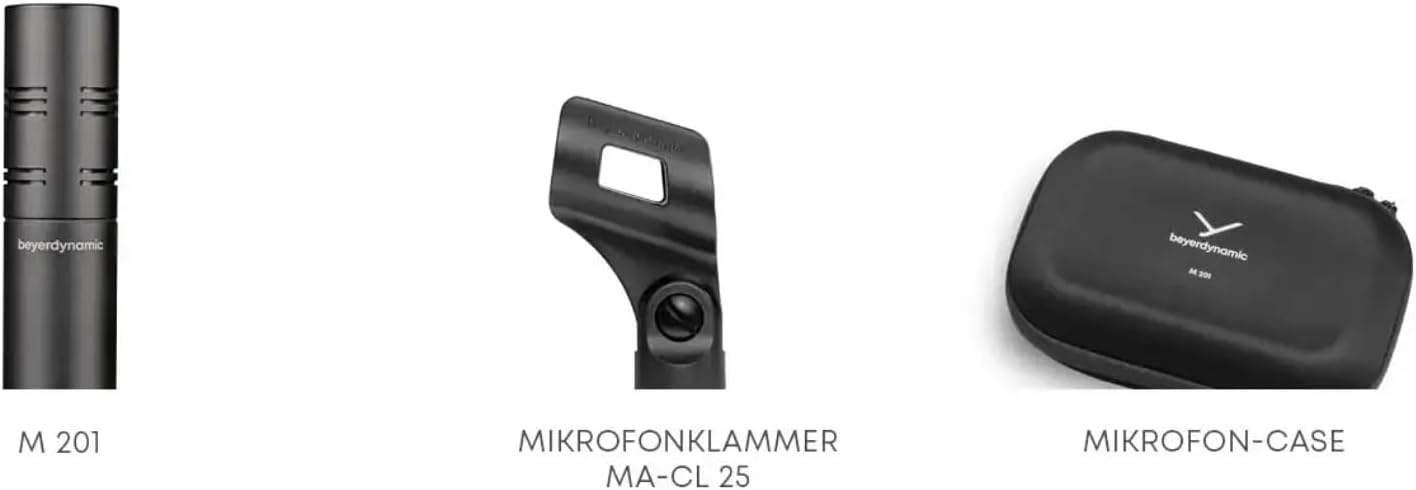
Image: The Beyerdynamic M 201 microphone, its MA-CL 25 microphone clip, and the protective carrying case.
4. Istruzioni per l'installazione
- Fissare la clip del microfono: Secure the MA-CL 25 microphone clip to a standard microphone stand.
- Microfono di montaggio: Carefully insert the Beyerdynamic M 201 microphone into the clip. Ensure it is firmly seated.
- Collegare il cavo XLR: Connect a balanced XLR cable (not included) to the microphone's XLR output and to an input on your audio mixer or audio interface.
- Posizionamento: Position the microphone appropriately for the sound source. The hypercardioid pattern is most sensitive directly in front of the microphone.

Image: The M 201 microphone mounted on a stand, positioned to capture sound from a snare drum. This illustrates a typical setup for drum recording.

Image: The M 201 microphone on a stand, capturing audio from an acoustic guitar. This demonstrates its use for acoustic instruments.

Image: The M 201 microphone placed in front of an electric guitar amplifier, suitable for capturing amplified instrument sounds.
5. Istruzioni per l'uso
The Beyerdynamic M 201 is a passive dynamic microphone and does not require phantom power. It is ready for use once connected to an appropriate input.
- Guadagno Stagin: Adjust the gain on your mixer or audio interface to achieve an optimal signal level without clipping.
- Effetto di prossimità: Be aware of the proximity effect, where bass frequencies are accentuated when the microphone is close to the sound source. Adjust positioning as needed for desired tonal balance.
- Rifiuto fuori asse: Utilize the hypercardioid pattern by aiming the microphone directly at the desired sound source and positioning unwanted sound sources in the null points (sides) of the microphone.
6. Manutenzione e cura
- Pulizia: Per pulire il corpo del microfono, utilizzare un panno morbido e asciutto. Non utilizzare detergenti liquidi o solventi.
- Pulizia della griglia: If the microphone grille becomes dirty, gently wipe it with a slightly damp cloth. Ensure no moisture enters the microphone capsule.
- Magazzinaggio: Quando non lo si utilizza, riporre il microfono nella custodia in dotazione per proteggerlo da polvere, umidità e danni fisici.
- Evitare gocce: While robust, avoid dropping the microphone as this can damage internal components.

Immagine: dettagliata view of the microphone's internal components during assembly, demonstrating the precision engineering.
7. Risoluzione Dei Problemi
| Problema | Possibile causa | Soluzione |
|---|---|---|
| Nessuna uscita audio |
|
|
| Suono distorto |
|
|
| Rumore di fondo eccessivo |
|
|
8. Specifiche tecniche
| Tipo di trasduttore | Dinamico |
| Modello polare | Ipercardioide (unidirezionale) |
| Risposta in frequenza | 40 Hz - 18 kHz |
| Sensibilità Audio | 58 dB |
| Impedenza | 200 Ohm |
| Signal-to-Noise Ratio | 76 dB |
| Connettore | XLR |
| Materiale | Metallo |
| Dimensioni (L x P x A) | 9.3 x 6.6 x 3.55 pollici |
| Peso | 1.4 libbre |
9. Informazioni sulla garanzia
Beyerdynamic products are covered by a manufacturer's warranty. For detailed information regarding warranty terms, conditions, and registration, please refer to the official Beyerdynamic webo contattare l'assistenza clienti. Conservare la prova d'acquisto per eventuali reclami in garanzia.
10. Assistenza clienti
For further assistance, technical support, or service inquiries, please visit the official Beyerdynamic website or contact their customer service department. Contact information can typically be found on the Beyerdynamic websezione di supporto del sito.
Official Beyerdynamic Websito: www.beyerdynamic.com