
1. Introduzione
The PQWT PQ125C is an advanced underground water leak detector designed for precise localization of leaks in pressurized pipelines. It features a user-friendly touchscreen interface, high-precision sensors, and intelligent analysis capabilities, making it suitable for both indoor and outdoor environments. This manual provides detailed instructions for the setup, operation, and maintenance of your PQWT PQ125C device.

Image: PQWT PQ125 Series Water Leak Detector, showcasing the main unit and various sensors.
2. Contenuto della confezione
The PQWT PQ125C kit includes the following components:
- Host Machine (Main Unit with Touchscreen)
- Maniglia di controllo
- Two Dual-Membrane Resonance Sensors (DMR-H40 & DMR-V59)
- Acoustic Cavity Re-Vibration Sensor (RC-S3)
- Noise-Reduction Headphones
- Listening Rod
- Tracolla
- Caricabatterie
- Cavo dati USB
- Custodia per il trasporto

Image: All components of the PQWT PQ125C kit laid out, including the host machine, sensors, headphones, and accessories.
Video: An unboxing video demonstrating the contents of the PQ125 Series Pipe Water Leak Detector package.
3. Caratteristiche del prodotto
- Funzionamento semplice: Factory-developed UI interaction system with touchscreen display, operational guidance, and error pop-ups for ease of use.
- Precise Localization: Two leak detection modes (General Detection and Location Mode) to quickly scan large areas and pinpoint exact leak points by comparing signal strengths.
- Sensori ad alta precisione: Equipped with two DUAL MEMBRANE RESONANCE SENSORS (DMR-H40 & DMR-V59) and an RC-S3 ACOUSTIC CHAMBER RESONANCE SENSOR, suitable for various indoor and outdoor environments.
- Tecnologia avanzata: Incorporates AI-enhanced assistance, dual-membrane resonance, acoustic cavity re-vibration, time-domain waveform dynamic display, sound-intensity focusing, multi-dimensional feature extraction, and Edge-AI intelligent analysis.
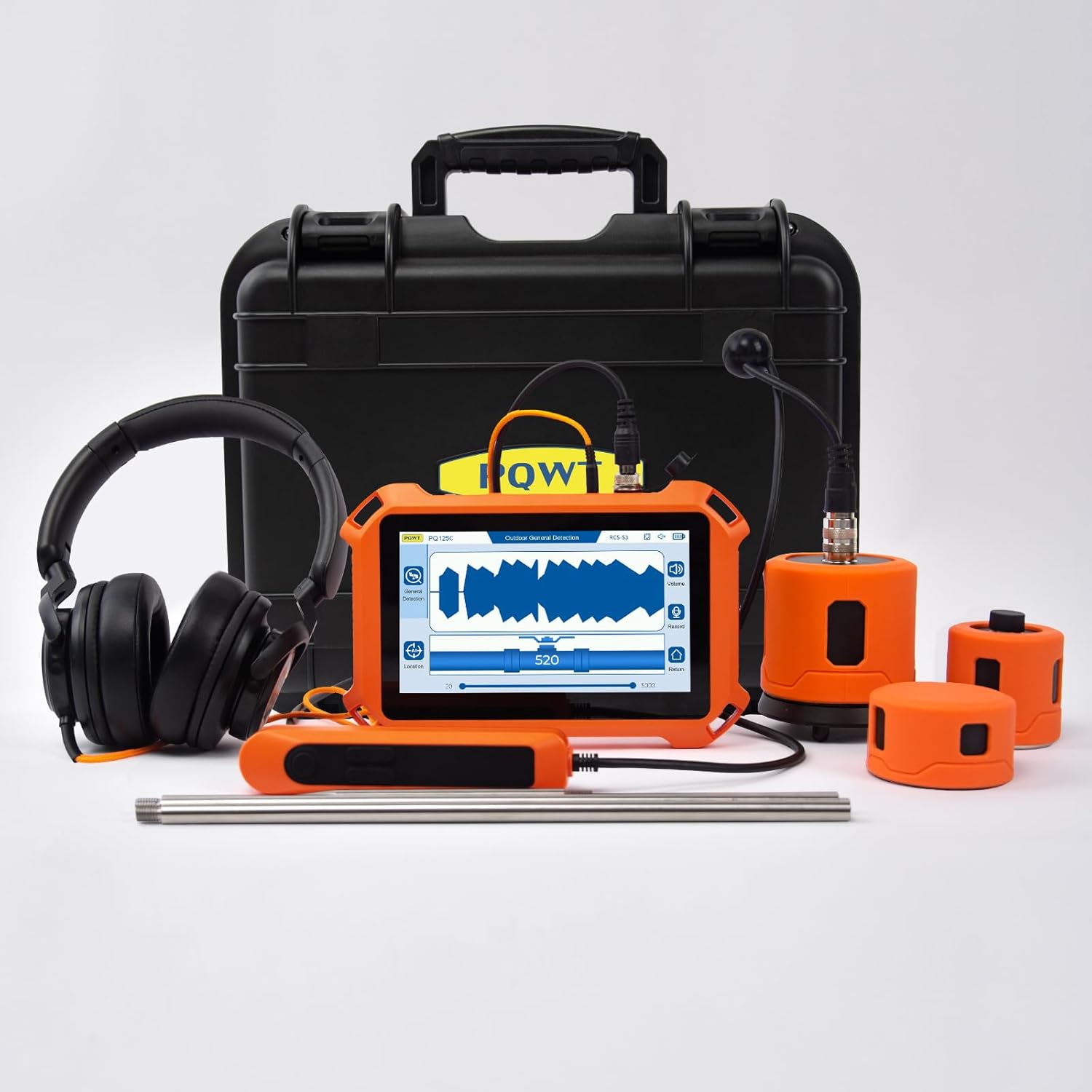
Image: The PQWT PQ125C main unit with its touchscreen display and an attached sensor, demonstrating its use in an urban environment.

Image: A close-up of the top-level acoustic sensor, highlighting its built-in preamplifier circuit for superior noise-capturing capability.
Video: A product introduction video for the PQWT PQ125C, detailing its eight core technologies and features.
4. Impostazione
Follow these steps to set up your PQWT PQ125C Water Leak Detector:
- Fissare la tracolla: Connect the host machine to the shoulder strap for comfortable carrying during operation.
- Connect Control Handle: Open the host machine's aviation connector cover, insert the aviation plug from the control handle into the host machine, and tighten.
- Collegare il sensore: Open the sensor's aviation connector cover, insert the aviation plug from the control handle into the sensor, and tighten the nut. Select the appropriate sensor (DMR-H40, DMR-V59, or RC-S3) based on the pipe diameter and environment.
- Collegare le cuffie: Plug the headphones into the headphone jack on the host machine.
- Accensione: Press and hold the power switch on the main unit for 3-5 seconds to turn it on. The system will boot up and display the main interface.

Image: Visual guide showing the assembly steps for the PQWT PQ125C, including connecting the strap, control handle, sensor, and headphones.
5. Istruzioni per l'uso
The PQWT PQ125C offers different detection modes for various scenarios.
5.1 General Detection Mode
This mode is used for quickly scanning large areas to identify potential leak locations.
- Place the sensor on the ground directly above the suspected pipeline.
- Using the control handle, adjust the volume and gain settings as needed (e.g., Volume to 5, Gain to 3).
- Press the control handle switch to start leak monitoring. Stay at each point for approximately 8-10 seconds.
- Move the sensor along the pipeline in 1-meter increments (for outdoor) or 0.5-meter increments (for indoor).
- Observe the time-domain dynamic waveform on the screen. If the sound differs or becomes louder, and the waveform is continuous with stable amplitude, this location may be a suspected leak.

Image: The General Detection Mode interface on the PQWT PQ125C, showing a dynamic waveform display.
5.2 Modalità di localizzazione
After identifying a suspected leak area with General Detection Mode, use Location Mode for precise pinpointing.
- From the General Detection Mode, tap to enter Location Mode.
- The screen will display 16 signal collection boxes.
- Place the sensor at the suspected leak point (center) and collect data.
- Move the sensor around the suspected point in all directions (e.g., front, back, left, right) and collect data at multiple points.
- Compare the signal strengths displayed in the boxes. The point with the highest signal strength indicates the exact leak location.

Image: The Location Mode interface on the PQWT PQ125C, showing signal strength comparison across multiple points.
5.3 Gas Tracer Detection (If applicable to your model)
For models equipped with gas tracer detection, this method can be used for difficult-to-locate leaks.
- Inject a hydrogen-nitrogen gas mixture (95% nitrogen, 5% hydrogen) into the pipeline.
- Connect the Tracer Leak Detection Sensor (TLS-H8) to the host machine and attach the telescopic rod.
- Press and hold the power button to turn on and enter the main interface. Tap to enter Gas Detection mode.
- Wait for the sensor to warm up for 3 minutes, then tap "Confirm" and reset the sensor data.
- Adjust the telescopic rod to a suitable length and move the Tracer Leak Detection Sensor close to the ground in a sweeping motion.
- When the sensor detects leakage gas, the signal bar and value will change. The closer to the leak, the higher the value; farther away, the value decreases.
- Note: Gas can only penetrate to the surface through permeable materials, so the highest reading point is not always the exact leak location. For higher accuracy, combine with Outdoor Detection mode.

Image: The Gas Tracer Detection interface on the PQWT PQ125C, showing gas concentration readings.
Video: A detailed operation video for the PQ125 Series Water Leak Detector, demonstrating both outdoor and indoor detection modes.
6. Scenari applicativi
The PQWT PQ125C is suitable for detecting leaks in a wide range of pressurized pipeline systems, including:
- Municipal water supply pipelines (outdoor)
- Fire-fighting pipelines
- Underground pressure pipelines
- Heating and radiator pipelines
- Underfloor heating networks
- Household fresh-water plumbing systems
- Other pressurized pipeline scenarios
7. Specifiche del prodotto
| Caratteristica | Dettaglio |
|---|---|
| Modello | PQ125C |
| Colore | PQ125C-Orange |
| Dimensioni del prodotto (L x P x A) | 8 cm L x 12 cm P x 15 cm A |
| Numero di batterie | Sono necessarie 2 batterie non standard (incluse) |
| Media integrati | Host, Headphones, Charger, USB Data Cable, Strap, Control Handle, Listening Rod, DMR-H40 sensor, DRM-V59 sensor, RCS-S3 sensor, Carry case |
| Temperatura di lavoro | -20°C a 50°C |
| Orario di lavoro | <8 ore |
| Profondità di misurazione | 3m |
| Frequency Acquisition/Adjustment Range | Indoor: 600Hz-15KHz, Outdoor: 20Hz-5KHz |
8. Manutenzione
To ensure the longevity and optimal performance of your PQWT PQ125C, follow these maintenance guidelines:
- Mantenere il dispositivo pulito e privo di polvere e detriti. Utilizzare un panno morbido e asciutto per la pulizia.
- Store the device and its accessories in the provided carrying case when not in use to protect them from damage.
- Avoid exposing the device to extreme temperatures, direct sunlight, or moisture for prolonged periods.
- Ensure all connectors are clean and dry before connecting them to prevent electrical issues.
- Charge the batteries regularly, even if the device is not in frequent use, to maintain battery health.
9. Risoluzione Dei Problemi
If you encounter issues with your PQWT PQ125C, refer to the following common problems and solutions:
| Problema | Possibile causa | Soluzione |
|---|---|---|
| Il dispositivo non si accende | Batteria scarica; il pulsante di accensione non è stato premuto abbastanza a lungo | Caricare il dispositivo; tenere premuto il pulsante di accensione per 3-5 secondi |
| Nessun suono dalle cuffie | Headphones not properly connected; Volume too low | Ensure headphones are fully plugged in; Increase volume using control handle |
| Letture imprecise | Incorrect sensor selection; High environmental noise; Improper sensor placement | Select appropriate sensor for pipe size/environment; Adjust gain; Ensure firm contact with surface |
| Lo schermo non risponde | System error; Device frozen | Press the reset button (RST); Power off and restart the device |
10. Garanzia e supporto
The main unit of the PQWT PQ125C comes with a two-year warranty and lifetime maintenance. For technical support, service, or warranty claims, please contact PQWT customer service through their official channels.
The device interface is available in 12 languages: English, Turkish, Italian, French, Spanish, Arabic, Russian, Korean, German, Portuguese, Polish, and Vietnamese.

