1. Introduzione
This manual provides essential information for the proper assembly, operation, and maintenance of your Whadda WMMI211 Air Quality Monitor. Please read these instructions carefully before using the device to ensure safe and efficient performance. The WMMI211 is designed to measure various environmental parameters including equivalent CO2 (eCO2), total volatile organic compounds (TVOC), barometric pressure, temperature, and humidity.
2. Informazioni sulla sicurezza
- Tenere il dispositivo lontano dall'acqua e da ambienti ad alta umidità.
- Non esporre il dispositivo a temperature estreme o alla luce solare diretta per periodi prolungati.
- Evitare di far cadere o sottoporre il dispositivo a forti impatti.
- Non tentare di aprire o modificare il dispositivo. Per qualsiasi intervento di assistenza, rivolgersi a personale qualificato.
- Use only the specified power adapter or USB cable for power supply.
3. Contenuto della confezione
Verifica che tutti i componenti elencati di seguito siano presenti nel tuo pacchetto:
- Main circuit board with display
- Environmental sensor module
- Wooden enclosure panels
- Cavo di alimentazione USB
- Connecting wires/ribbon cable
- Screws and nuts for assembly
- Small screwdriver (if included)

Figura 3.1: All components of the Whadda WMMI211 Air Quality Monitor kit, including circuit boards, display, wooden panels, cables, and fasteners.
4. Installazione e assemblaggio
The Whadda WMMI211 is provided as a kit requiring assembly. Follow these steps carefully:
- Preparare i componenti: Unpack all components and identify each part as per the package contents list.
- Assemblaggio del contenitore: Carefully interlock the wooden panels to form the main enclosure. Ensure the display opening is correctly oriented.
- Mount Main Board: Secure the main circuit board into the designated slots or standoffs within the enclosure using the provided screws and nuts.
- Connetti Display: Connect the display module to the main circuit board using the ribbon cable. Ensure the connection is firm and correctly oriented.
- Installare il modulo sensore: Connect the environmental sensor module to the main board using the appropriate connecting wires. Position the sensor module in its designated area, often with ventilation slots.
- Pannelli protetti: Once all internal components are connected, secure the remaining wooden panels, ensuring all screws are tightened gently to avoid damaging the wood.
- Collegamento elettrico: Connect the USB power cable to the device's USB port and then to a suitable USB power source (e.g., a computer USB port or a 5V USB power adapter).
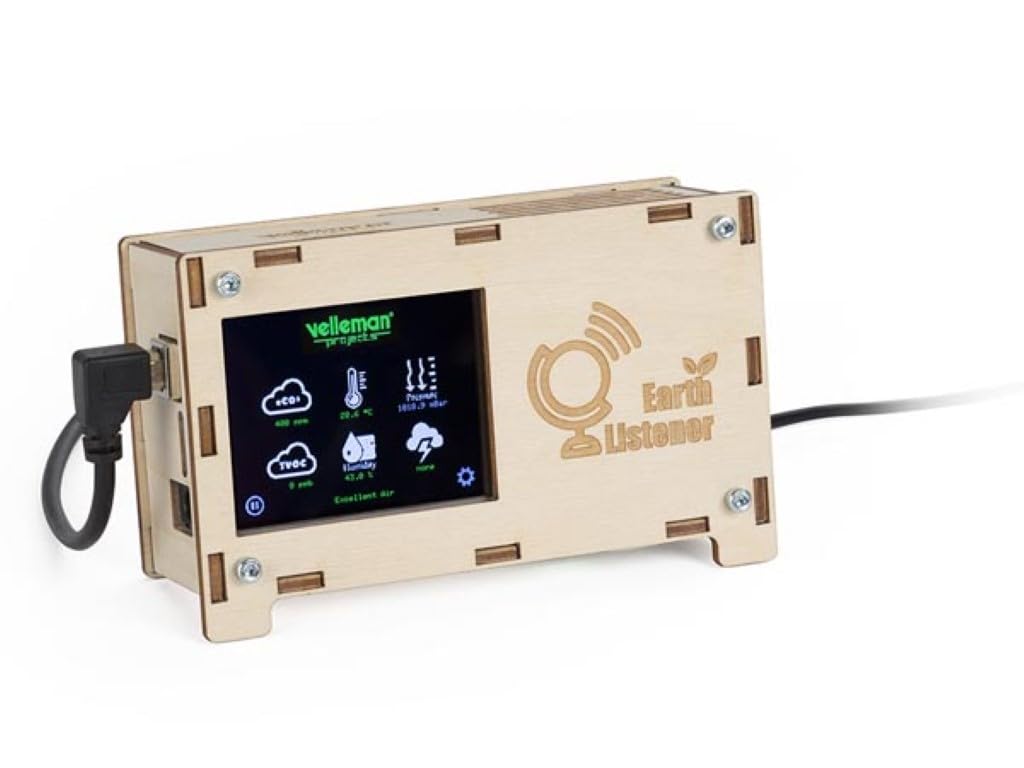
Figura 4.1: Davanti view of the fully assembled Whadda WMMI211 Air Quality Monitor, showing the display and USB power connection.

Figura 4.2: Lato view of the assembled Whadda WMMI211, highlighting the wooden enclosure and fasteners.
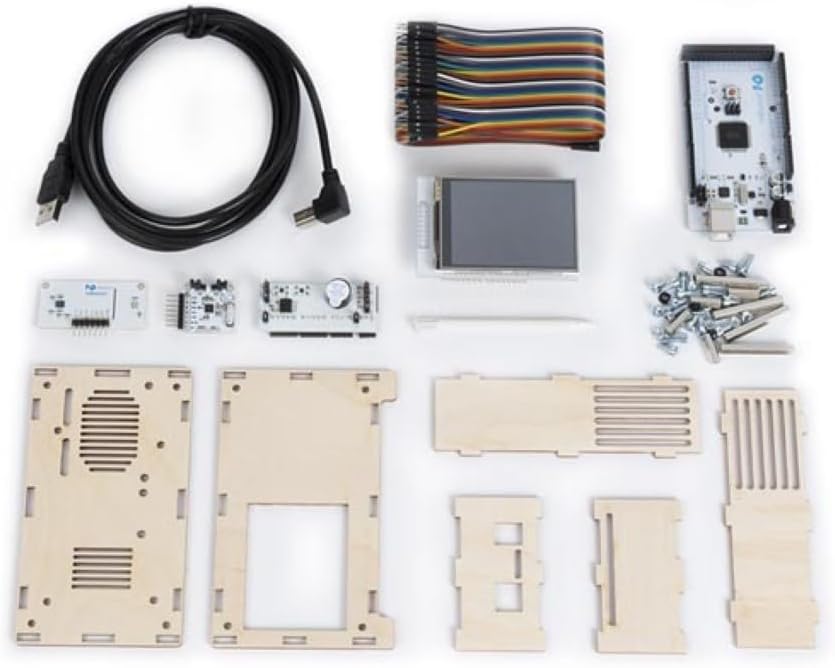
Figura 4.3: Metter il fondo a view of the assembled Whadda WMMI211, showing ventilation slots for sensor operation.
5. Istruzioni per l'uso
Once assembled and powered, the Whadda WMMI211 will automatically begin to display environmental readings.
- Accensione: Connect the USB cable to a power source. The device will power on automatically and the display will illuminate.
- Riscaldamento iniziale: Allow the device approximately 5-10 minutes for the sensors to stabilize and provide accurate readings.
- Lettura del display: The display shows various parameters with corresponding icons:
- eCO2: Equivalent Carbon Dioxide levels (in ppm).
- TVOC: Total Volatile Organic Compounds (in ppb).
- Temperatura: Ambient temperature (in °C or °F).
- Umidità: Relative humidity (in %).
- Pressione: Barometric pressure (in hPa or mbar).
- Navigation/Settings: If buttons are present (as indicated by a gear icon on the display), they typically allow you to cycle through display modes, adjust brightness, or access calibration options. Refer to the on-screen prompts for specific functions.
- Spegni: Disconnect the USB power cable to turn off the device.
6. Manutenzione
- Pulizia: Gently wipe the device's exterior with a soft, dry cloth. Do not use liquid cleaners or abrasive materials. Ensure no dust or debris obstructs the sensor ventilation slots.
- Magazzinaggio: Quando non in uso, conservare il dispositivo in un luogo fresco e asciutto, lontano dalla luce solare diretta e da temperature estreme.
- Calibrazione del sensore: The sensors are typically factory-calibrated. If you suspect inaccurate readings, consult the manufacturer's support for potential recalibration procedures.
7. Risoluzione Dei Problemi
| Problema | Possibile causa | Soluzione |
|---|---|---|
| Il dispositivo non si accende. | Nessuna alimentazione o collegamento difettoso. | Check USB cable connection and power source. Try a different USB port or adapter. |
| Display is blank or shows errors. | Loose display cable or software issue. | Ensure display ribbon cable is securely connected. Power cycle the device. |
| Le letture sembrano imprecise. | Sensor warm-up period not complete, or environmental interference. | Allow 5-10 minutes for sensor stabilization. Ensure device is not near strong air currents, heat sources, or chemical fumes. |
| Il dispositivo non risponde. | Problema temporaneo del software. | Disconnect power for 10 seconds, then reconnect to perform a hard reset. |
8. Specifiche
- Numero modello: WMMI211
- Produttore: Che cavolo
- Dimensioni del prodotto: Dimensioni: 17.78 x 12.7 x 6.35 cm
- Peso dell'articolo: 425.24 g (15 once)
- Caratteristiche speciali: Measures eCO2, TVOC, Barometric Pressure, Temperature, Humidity
- Alimentazione elettrica: USB 5V (via USB cable)
9. Garanzia e supporto
For warranty information, technical support, or service inquiries, please refer to the official Whadda websito o contatta il tuo rivenditore. Conserva la ricevuta d'acquisto come prova d'acquisto.


